Four Points of Growth: What Revenue Operations Maturity Is Actually Worth
Most founders we speak to are in roughly the same position. Revenue is growing. The team is bigger than it was a year ago. And somewhere between marketing, sales and customer success, something is leaking. Deals stall without a clear reason. The forecast is a negotiation rather than a number. Two people pull the same report and come back with different answers.
The instinct at that point is usually to add something. More headcount, a new tool, an AI layer. The evidence suggests the return is in fixing what is already there.
The number worth starting with
Forrester Consulting, in research commissioned by Salesforce and published in November 2024, surveyed 927 global decision-makers and scored them on revenue operations maturity. Organizations in the high maturity group delivered a 10% five-year revenue growth rate. Those in the low maturity group delivered 6%.
Four percentage points, compounding over five years, for getting your operating model right.
The same study found only 25% of the sample qualified as high maturity. Nearly half sat in the middle, and just over a quarter at the bottom. So, this is not a marginal advantage available to everyone. Most companies are leaving it on the table.
It is worth being clear about what the research does and does not show. It is a correlation across a large sample, not a controlled experiment, and well-run companies tend to be well run in several respects at once. But the direction is consistent with what we see in practice, and the mechanism is not mysterious.
What maturity actually means
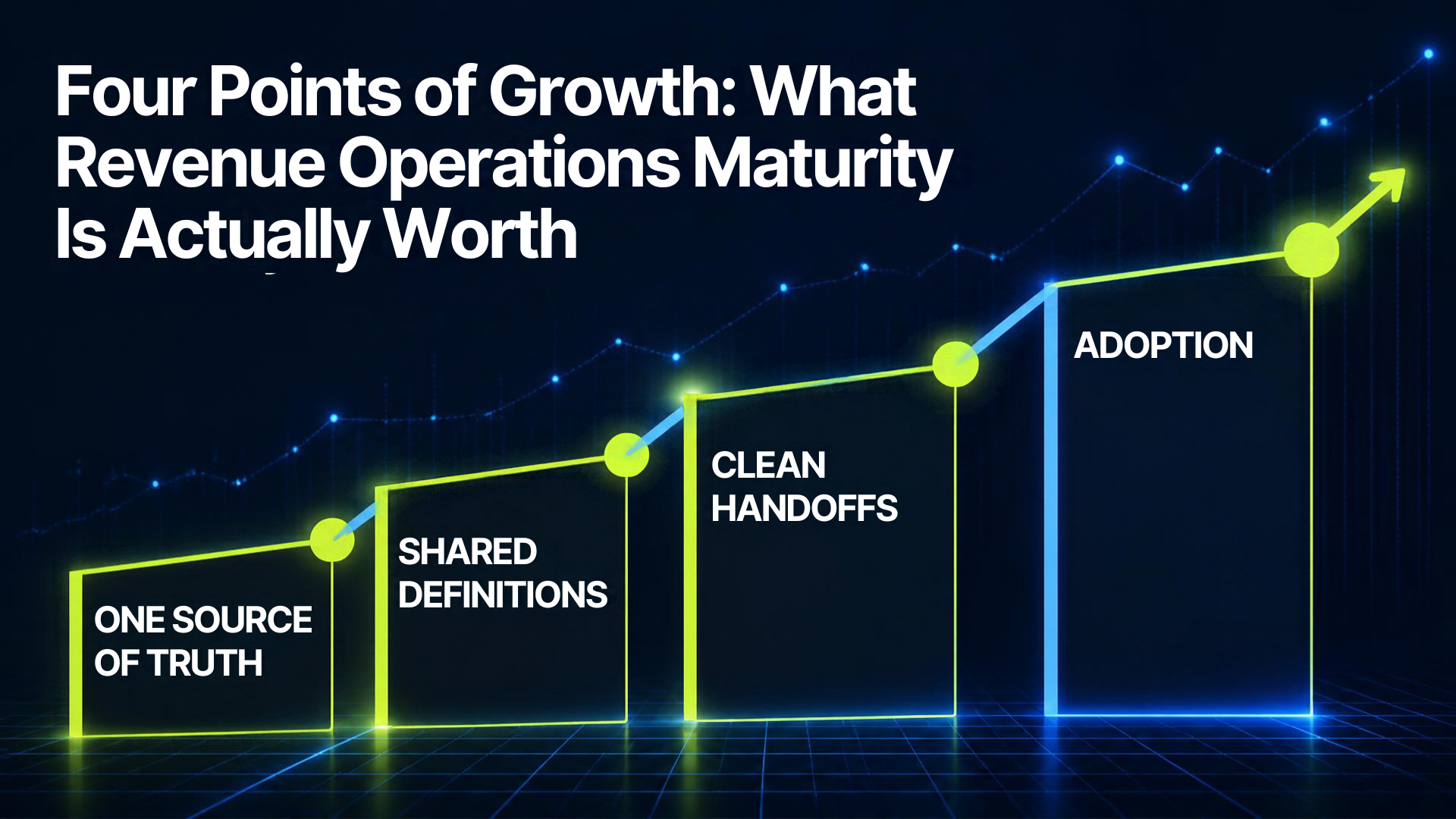
Maturity here is not sophistication. It is not the size of your tech stack. It is four unglamorous things, and the gap between companies is usually in how honestly, they have done them.
One source of truth. A single system where the revenue record lives, with clear ownership of every field that matters. Not a CRM plus three spreadsheets plus a shared drive plus what the sales director keeps in his head. When the answer to “what is in the pipeline” depends on who you ask, you do not have a forecast. You have opinions.
Shared definitions. What counts as a qualified lead. When an opportunity moves stage and what evidence is required. What a renewal at risk looks like. Written down, agreed across marketing, sales and customer success, and enforced in the system rather than relitigated in meetings.
Clean handoffs. Most revenue leaks at the seams. Marketing to sales. Sales to onboarding. Onboarding to account management. Each handoff needs an owner, a trigger and a standard for what gets passed across.
Adoption. A process nobody follows is a document, not an operating model. This is the hardest of the four and the one most often skipped, which is why we treat it as part of the build rather than a post-launch afterthought. There is a telling gap in the data on this. Salesloft’s Rise of RevOps to the C-Suite study, run by Wakefield Research with 400 US respondents in July 2025, found 73% of companies now have a revenue operations role in the C-suite, while 89% still lack clearly defined strategic goals for the function. Plenty of organizations have hired the title. Fewer have done the work.
Why this decides your AI return
The reason to fix the foundations now rather than next year is that everything being sold to you at the moment sits on top of them.
An AI layer has no judgment about your business. It inherits your definitions, your data and your process, then runs them faster and at greater volume. Bad data becomes bad decisions at scale. Gartner puts the average cost of poor data quality at a minimum of $12.9 million a year per organization, and in a revenue context that shows up as duplicate accounts, stale contacts and opportunities parked in stages nobody has touched for six weeks. Point a scoring model at that and you have automated the guesswork. If three account executives each run discovery their own way, an assistant trained on that activity will produce three versions of what good looks like. You have not standardized anything. You have industrialized the variance.
The people already trying this say the same thing. In Salesforce’s 2026 State of Sales report, based on 4,050 sales professionals across 22 countries, 51% of sales leaders using AI said disconnected systems were slowing their initiatives down. The same report found the average seller spends 40% of their time actually selling. Before you add anything, six of every ten hours you pay a salesperson for go somewhere other than selling.
Where to start
You do not need a transformation program. You need ninety days and some honesty.
Pick your three most important revenue metrics and trace each one back to the field it comes from. If you cannot reach a single reliable source in under five minutes, that is your first project. Then audit the handoff your team complains about most and fix the trigger and the ownership. Then look at what your salespeople spend their non-selling hours on and remove the largest item.
Do that and the four-point gap starts to close on its own. The AI conversation also changes completely. You stop asking which tool to buy and start knowing which task is worth automating and what a good result would look like.
We would rather tell you your operations are not ready than sell you a pilot. Clean foundations turn technology into a genuine advantage. Without them, it is expensive noise.
By Leo Carcamo
leo.carccamo@236works.com
© 2026 236 Works Limited. All rights reserved.