Thirty-Six Percent: What Deal Slippage Tells You About Your Forecast
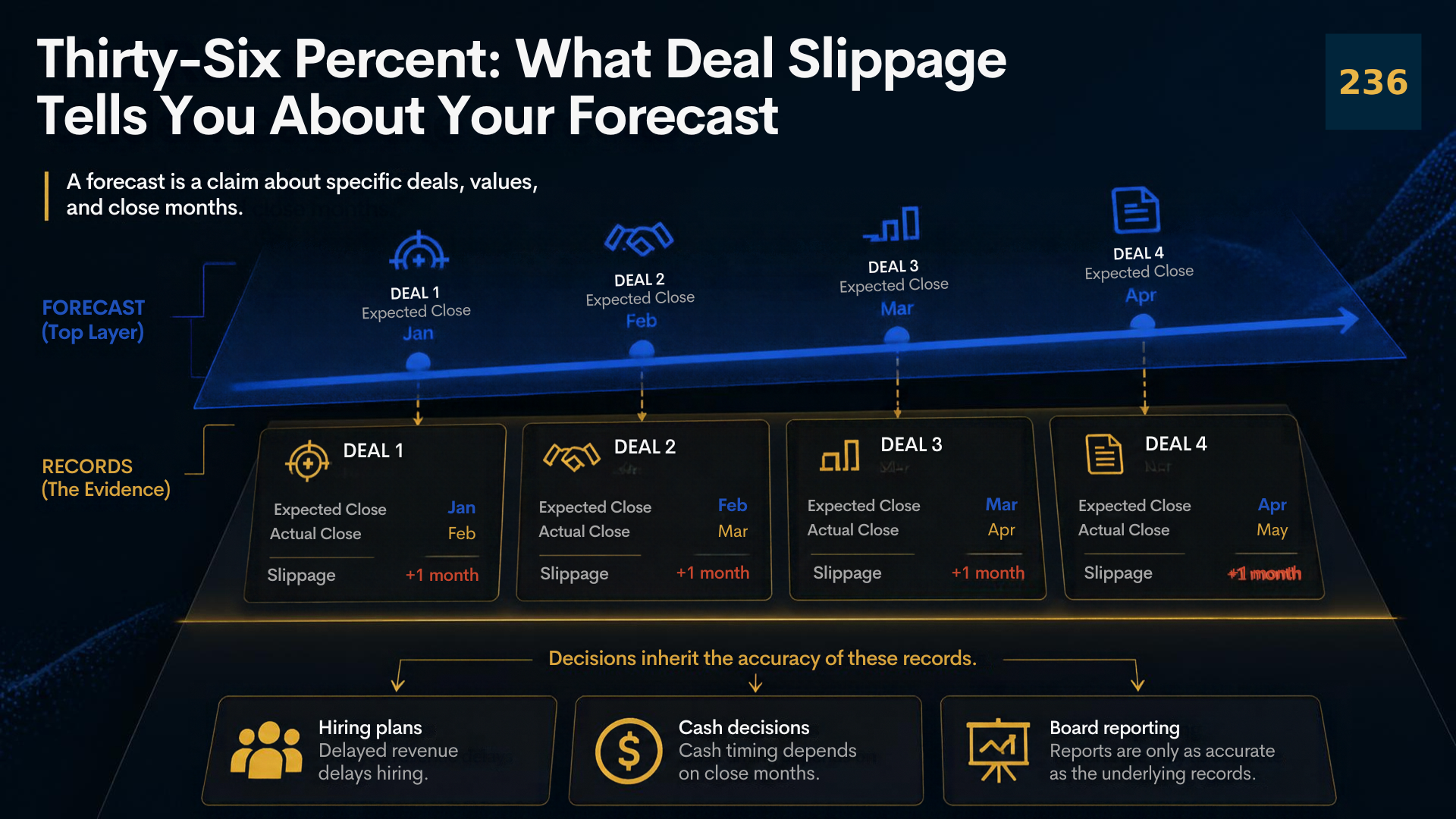
Most forecast conversations are about the number. Whether it is achievable, whether the team believes it, what happens if it misses.
The more useful conversation is about the records underneath it. A forecast is not a prediction. It is a claim that a specific set of deals will close, at specific values, in a specific month. Everything you plan on the back of it, hiring, cash, what you tell your board, inherits the accuracy of those individual claims.
There is now good evidence on how accurate they are.
The number behind the number
Ebsta and Pavilion analyzed 655,000 B2B opportunities worth $48 billion, alongside a survey of more than 2,000 CROs and sales leaders, for their 2025 GTM Benchmarks report. They found that 36% of deals slipped.
More than a third of the pipeline did not close when it said it would.
The same report found 78% of sellers missed quota, up from 69% the year before. So this is not a small timing inconvenience at the edges. It is most of a sales organization missing, in a year when more than a third of deals moved.
And these are not opinions about forecasting. This is observed behavior in real CRM records, which makes it considerably harder to argue with than a survey asking people how confident they feel.
Why a deal slips without warning
Here is the finding from that same research that should change how you run your pipeline: 76% of deals worked by average performers lacked a critical event.
A critical event is the buyer’s reason to act by a date. A contract expiry. A board meeting. A system being switched off. A regulatory deadline. Something that makes doing nothing more expensive than doing something.
Without one, there is no force pulling the deal to a close date. The date exists only because your rep typed it in. It will move, and it will keep moving, and nothing in your CRM will flag it, because from the system’s point of view a deal with no critical event looks identical to a deal with one. Same stage. Same value. Same probability weighting.
That is the mechanism. Three quarters of the deals your average reps are working have nothing anchoring them to a date, and your forecast is counting them at full weight anyway.
Conditions are making it worse rather than better. In Salesforce’s 2026 State of Sales report, based on 4,050 sales professionals across 22 countries, 57% said sales cycles are getting longer. Longer cycles mean more opportunities for a date to move, and more time for a buyer’s priorities to change underneath a deal that your pipeline still shows as healthy.
Three things to fix
Make stage criteria about the buyer, not your team. If an opportunity moves to Proposal because a proposal was sent, you are tracking your own activity. The stage tells you nothing about likelihood. Write exit criteria in terms of what the buyer has done. Not “we demoed” but “the economic buyer has confirmed budget and a decision date”. One of those is checkable by somebody other than the rep. The other is not.
Make the critical event a required field. Given the 76% figure, this is the single highest-return change available to most companies. One field, filled in with the buyer’s reason to act by their date, and a rule that a deal cannot enter your final stage without it. Deals that cannot produce one are not late-stage deals, whatever the stage says, and should not carry full weight in the forecast.
Track slip, with a reason. Most CRMs will let a close date move indefinitely and leave no trace. Record every change and why. After one quarter you have something better than any predictive model: a record of which deals actually move when they say they will, and whose dates you can trust. Slip becomes a measurable thing rather than a quarterly surprise.
Then change the inspection. A forecast call that asks people how confident they feel is measuring personality, and personality varies more between your reps than your deals do. Ask instead what has changed since last week, and what evidence supports the date. Deals without an answer go to a different category.
The honest version
You will not reach a perfect number. Nobody does, and anyone promising one is selling something. What you can reach is a forecast that misses in the same direction, by roughly the same amount, every quarter. That sounds like a low bar. It is not. A number you know runs 15% hot is a number you can plan against, because you simply discount it. A number that lands 5% under one quarter and 30% over the next is not a forecast at all, however good its average looks.
None of the above is a technology project. It is field definitions, entry criteria and a review that asks better questions. Salesforce’s 2026 report found 79% of high performing sales organizations prioritize data hygiene, against 54% of underperformers. The gap between good and bad here is not talent or tooling. It is whether someone does the unglamorous work, and keeps doing it.
Which is the same conclusion we reached in our piece on the Four Points of Growth gap between high and low revenue operations maturity, arriving from a different direction. The forecast is downstream of the foundations. So is everything you are planning to build on top of it.
By Leo Carcamo
leo.carcamo@236works.com
© 2026 236 Works Limited. All rights reserved.