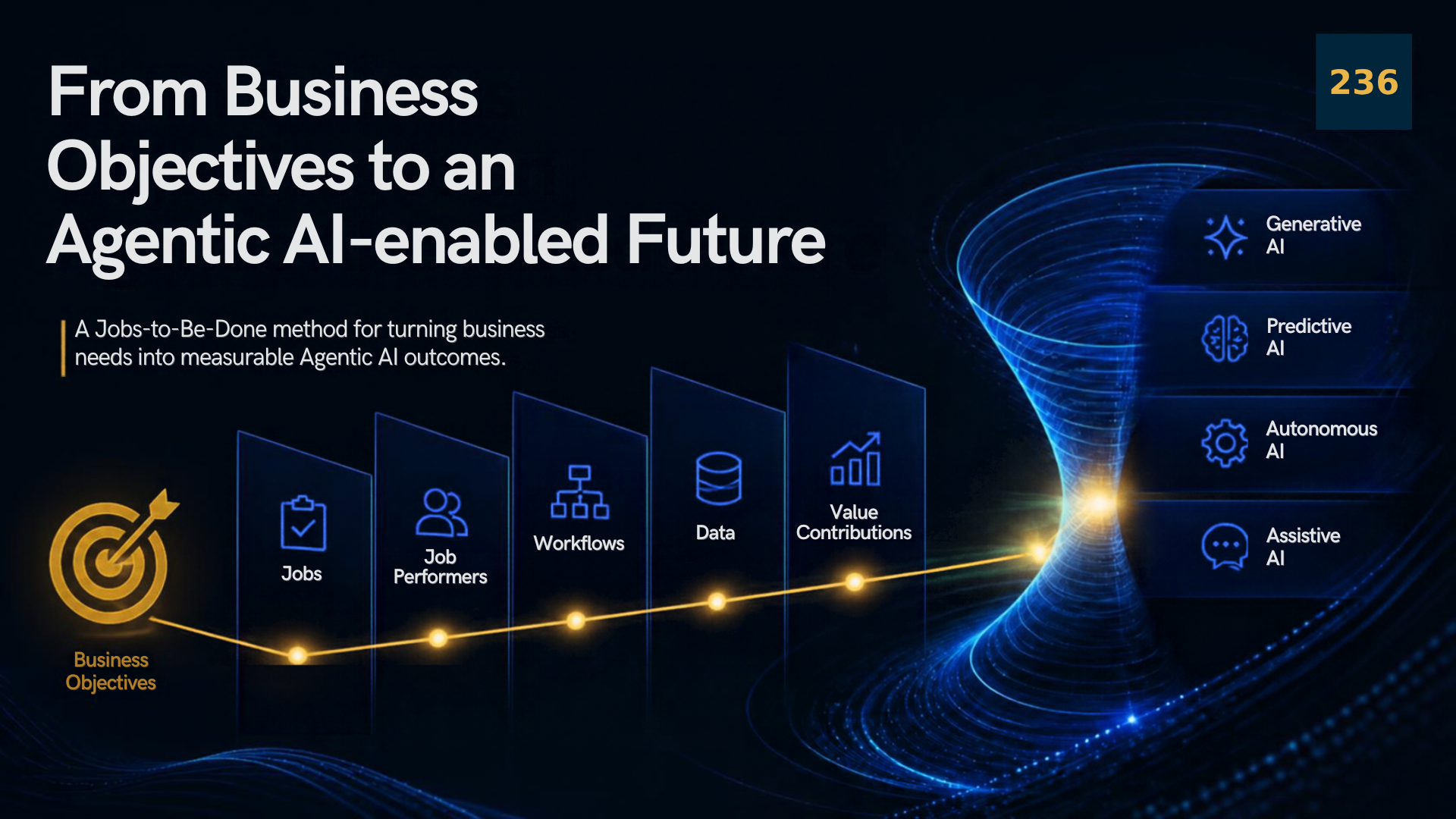
From Business Objectives to an Agentic AI enabled future
Paul Bertucci••13 min read
A Business Outcome focused “Bridge to Agentic AI” using Jobs to be Done [1] principles
Paul Bertucci – Strategic/Distinguished Architect and CTO with contributions from Jose Solera – Fractional CIO/PMO Leader
Abstract
This paper presents a rigorous, outcome‑driven method for guiding organizations into an Agentic AI–enabled future by anchoring all transformation efforts in Jobs‑to‑Be‑Done (JTBD) principles. Rather than beginning with AI use cases, the framework identifies the right business needs, the right locations within workflows, and the right Agentic AI capabilities that directly advance measurable business outcomes. By rapidly mapping an organization’s Jobs, Job Performers, required data, and value contributions, leaders gain a stable, high‑fidelity representation of how their business actually operates. This map becomes the foundation for pinpointing high‑value, high‑friction, and high‑cost Jobs where AI and Agentic capabilities – assistive, autonomous, predictive, or generative – can be applied with precision. The approach enables targeted prototyping, scalable Agent design, and continuous value measurement, ultimately supporting a shift toward the emerging “Judgment Economy,” where abundant execution capacity elevates the importance of distributed, high‑quality decisionmaking. The result is a practical, repeatable bridge from business needs to Agentic AI outcomes that accelerates organizational performance, coherence, and long‑term value creation.
The Promise
“My business is finally operating at optimal Agentic AI speed!”
How did that happen? If you are not identifying the “right place” (the WHERE), the “right Agentic AI capability” (the WHAT), and the business outcome you are driving for (the WHY), you will never reach an efficient and optimized business future that is fully AI and Agentic enabled. This is likely the single most frustrating hurdle businesses are currently facing as they attempt to move into the Agentic AI world. Their focus has been on the AI or Agentic use cases – the shiny new toy and NOT on what their business needs, where specifically they should be using Agentic AI, and why – the value they will achieve and how it is enabling their business outcomes.
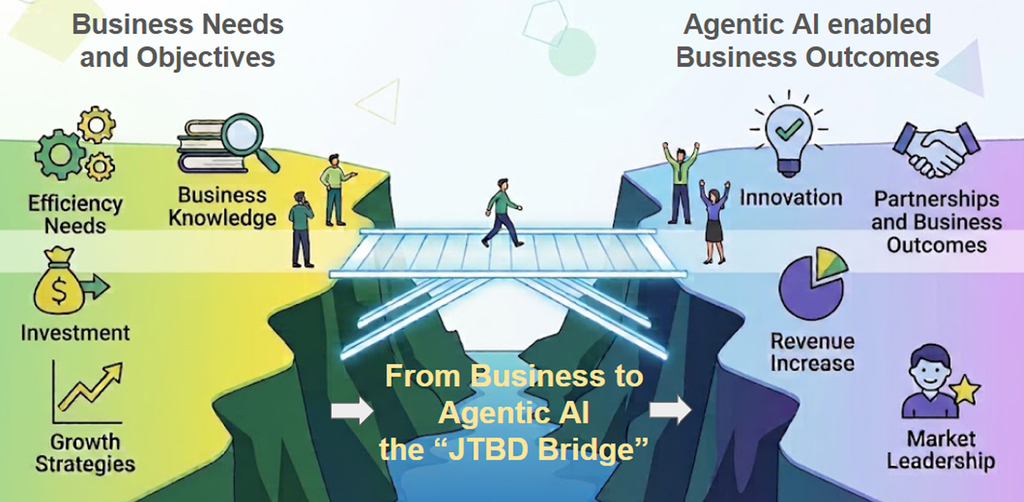
The “Business Needs” with “Jobs To Be Done” principles approach fills this shortcoming naturally within your organization’s actual work needs. It also yields a consistent, stable business framework that will drive all optimization, is tightly aligned to your business needs and objectives, creates an exceptionally accurate representation of how your business functions, and provides you with the ability to identify the What, Where, How and Why to leverage emerging Agentic AI capabilities. It is designed to directly drive high business value for years to come – building that “bridge” from your Business needs to Agentic AI enabled Business Outcomes – as depicted in Figure 1.
Figure 1 – From Business to Agentic AI enabled outcomes – the JTBD Bridge
We’ll break this down into 5 easy-to-follow parts:
Part 1 – Jobs to be Done principles Part 2- A Business Needs JTBD representation of a business Part 3 – Bridging the Business needs to Agentic AI capabilities in the right place Part 4 – Translating these capabilities into Agents and AI specifications/concepts Part 5 – Delivering the Business Outcome and Value
Part 1 – Jobs to be Done framework principles
The Jobs-to-be-Done (JTBD) framework operates on the premise that customers or businesses “hire” job performers to do a Job that they need to get done for their business (or with your business). Central to this framework is identifying the Job Performer – the specific individual or entity [or thing] who performs . An organization would want to collect and organize all of its Jobs into an ordered “Job Map” to form the core representation for what Jobs your organization is actually doing and what the jobs objectives/outcomes would be. It will be from this Job Map that you drive what your business needs into what Agentic AI (and any other capability or change) can be leveraged to “optimize” your business, exactly where it should be done, and why (what value) will be achieved and how it is enabling their business outcomes.
The Core Principles of JTBD
● Jobs achieve a goal or some type of outcome – Customers or Employees look for things to help them overcome an obstacle or improve their current situation. ● Jobs are enduring – The need stays the same over time, while the technology used to solve it may change. (e.g., The job of “sharing a message quickly across distances” evolved from smoke signals to telegrams to phones and so on). ● The “Job” may also be defined by its emotional and social dimensions, not only functional ones – A job is rarely purely technical. Buying a luxury watch fulfills the functional job of telling time, but the social job of status and the emotional job of feeling successful are often the real drivers. ● A “Job” may be a process or one or more task(s), not simply a discrete event – A job has a clear beginning, middle, and end, occurring within a specific context or circumstance or size. There can be Big Jobs, Small Jobs and Micro Jobs. These are specified in a hierarchical model/mapping with Big Jobs on the top and Micro Jobs at the lowest level. Optionally, there may also be some very high-level “Aspirational Jobs” that contain one or more Big jobs. ● To successfully apply JTBD, you must clearly define who is executing the job. Identifying the Job Performer ensures you design for the right persona and understand the exact friction they experience. In this era, a Job Performer can be a human or an AI request/response (Predictive/Generative) dialog or a Digital Worker Agent (assistive, autonomous, MCP/Orchestrated). ● We also always ask about what data/information is needed by the Job. Most Job Performers are passionate about what they need to do their job. Capture this core data scope!
Part 2- A Business Needs and Value JTBD representation of your business
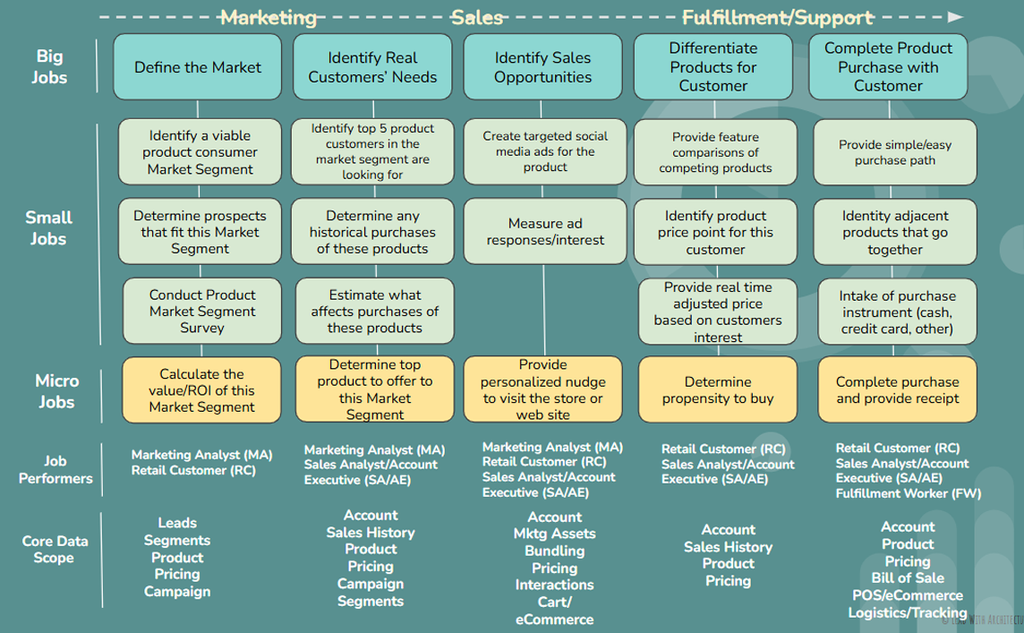
You can quickly identify a highly accurate JTBD Map across your entire organization in just a couple short days (we have been doing this for small, medium and large organizations for many years globally). It is ALL in business terms, represents real business work flows, and is driven down to the needed granularity (small or micro jobs) as needed. It also becomes easy to validate and, in turn, utilized to clearly understand what your business does, who the job performers of each job are (often cross-domain performers), and what outcomes must be achieved by each job. And, lastly, what data or information is critical for each job. This becomes extremely important as you start to think about adding in AI or Agents that will need certain data, semantic/contextual information and how this needs to be made available to job performers to optimize your business. Figure 2 gives you an idea of what a real company sub-set JTBD Map may contain (this one has 25 jobs, typically we see 150 – 200 jobs when doing the entire enterprise). Jobs are organized hierarchically within each Big job. In this example, the big job of “Defining the Market to sell too” is the main job to begin with, it is then broken down into smaller jobs like “identifying a viable market segment for your consumer products to target”, all the way down to “determining the value or ROI” of an identified market segment. Job performers are also identified and the core data that is utilized for these jobs. The value of each Job will also be initially estimated (magnitudes at the beginning – High, Medium, Low value (outcomes), then detailed value calculations to feed the prioritizations for the organization at the right time.
A bit later, we will introduce something called the “Judgement Economy” that is being enabled (a mindshift change) by the dramatic increase in Agentic AI and the execution abundance it unlocks [3].
Figure 2 – Jobs to be Done example and the resulting Job Map
Part 3 – Bridging the Business needs to Agentic AI capabilities (in the right place!)
A few critical things can now be tackled. It begins by holding a short assessment exercise that quickly drives out the top areas to focus on within the Jobs to be Done Mapping that will benefit most from ANY optimization, AI and Agentic Capabilities, and other high impact changes that may be needed. A few commonquestions to apply to each job are:
● “Of these jobs, which may be combined, simplified, are constrained, missing something, need uplifting or need to be eliminated?”, ● “Of these jobs, which ones directly (and strongly) contribute to value (result in significant and important outcomes)?” High, Medium, Small is fine for now. ● “Of these jobs, which are bottlenecks, heavily cognitive, or extremely manual? ● And, “of these jobs, which are the most expensive to execute?”
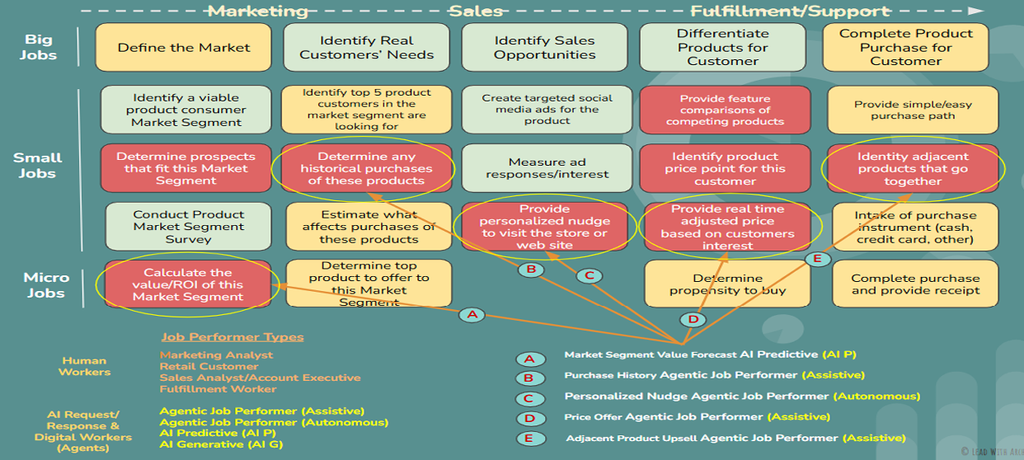
We color code these into Red, Yellow and Green visually where Red indicates that there are many changes that need to be done (maybe even severe gaps) + are very manual + are very expensive to do + heavily contribute to business value. Yellow indicates that there is still room for improvement + are moderately complex/manual and Green is the job is working fine or maybe even industry best practice + valuable + fairly efficient (has been optimized). This exercise accurately identifies exactly where you need to enable AI or Agentic capabilities! Never just randomly spread AI or Agentic capabilities around your organization and hope for the best. Always utilize a rigorous method to rapidly, accurately and optimally apply AI and Agents to only those areas that will yield the highest returns and optimization value to your company (or customers) – the Reds are screaming at you to invest in for ALL the right reasons. In our example, not all reds need AI, just the ones that will benefit from AI.
The second part of this exercise identifies WHAT change opportunity type will provide the best short term and long term impact (flexibility, value, outcome, optimization (rethinking), TCO, … .) for the AI/Agentic capability type that can help the most. You will find that when you are focusing on “a job” there are some industry “blueprint” AI or Agentic options to leverage that are already proving out to be the most effective for certain types of things (AI: Next Best Action, AI: Scoring/Probability, AI: Upsell strategy, AI: Generative, Agentic: Assistive dialogs, planning, Agentic: Autonomous Order Management, Payments, so on). Every industry will have a fairly robust number of “Industry blueprint” AI and Agentic capabilities to leverage. We can provide you with some of these. This library of industry blueprint AI/Agentic capabilities grows every second. There are also some very unique opportunities your organization may be able to provide as well (your secret sauce so to speak or a creative rethinking of how something is better done with AI). Figure 3 illustrates the jobs that we identified in this process that would benefit from change for all the right reasons. Again, a very surgical and specific focused effort that can be targeted, measured, and expanded to get the value and outcomes you are looking for. Once implemented, you should also build in the “value measurement capabilities” so you can see how much value you gain and if any drift or other factors may also tell you to change it or remove it as needed.
Figure 3 – What Job to focus on for change (AI, Agentic, Optimization)
Part 4 – Translating these capabilities into Agents and AI specifications/concepts
What we are seeing with our clients is that after this critical exercise is completed, they use this opportunity to do some rapid prototyping with Claude Code, Vibe or another AI coding platform that can be easily connected to CRM sources they have in sandboxes along with other external data that might be needed (see data scope).
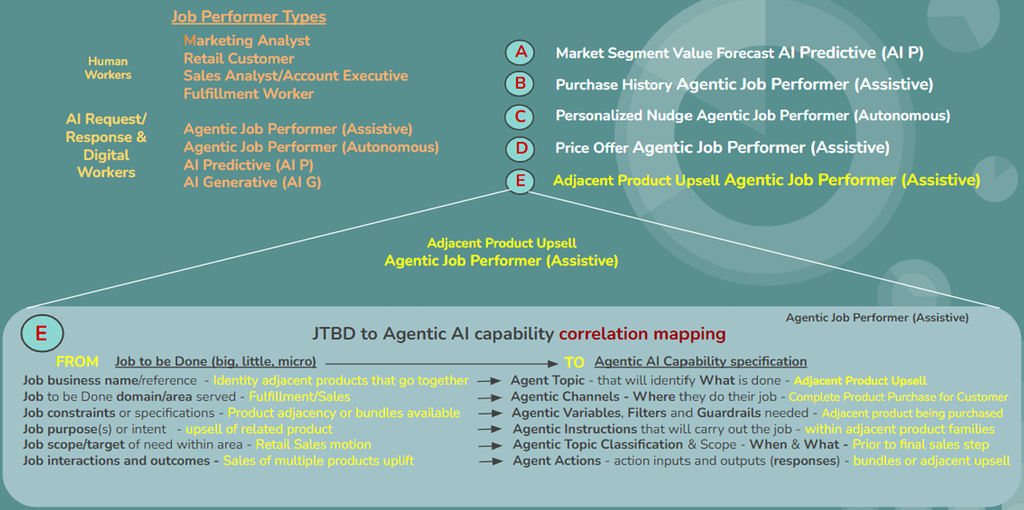
The example in Figure 4 shows an assistive Agent that can be created naturally from the Jobs to be Done small job map that we identified and assessed/prioritized (Red) that we described earlier. This easy and accurately placed Agent can now be tested in the workflow of the sales motion to help them identify “adjacent” products that might be desirable to go along with the one the customer is purchasing – this is an Adjacent Product Upsell Agent. The business can immediately get a feel of this newly enhanced workflow as well as early estimates of probable value and business outcomes.
Figure 4 – JTBD to Agentic AI correlation mapping
Part 5 – Delivering the Business Outcome and Value
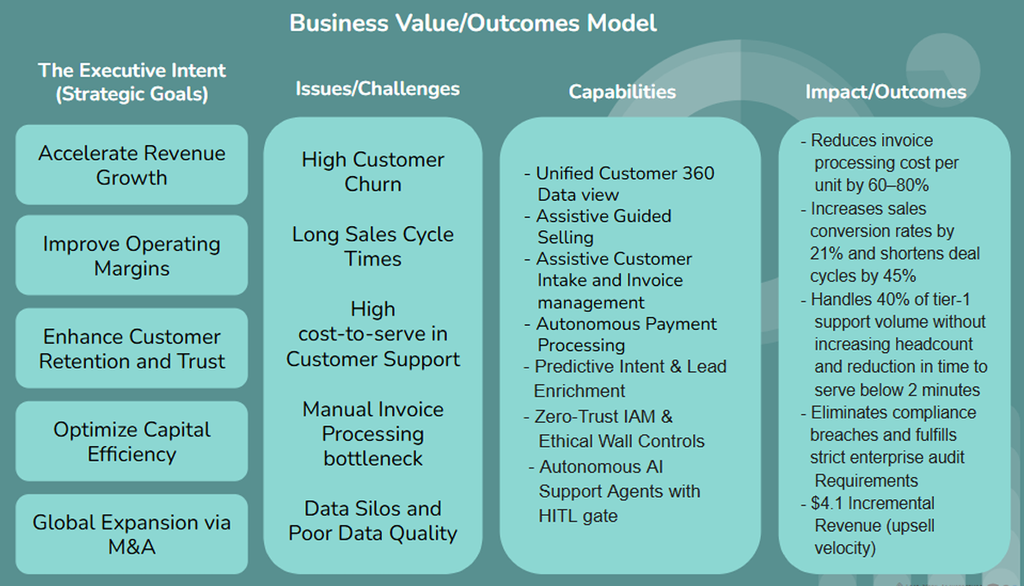
Determining what is valuable enough to pursue becomes the key focus that should be focused on first. Don’t just make change to make change – rigorously identify where change is the most valuable and what type of change would be optimal (whether this is simply process optimization or if it is a good candidate for AI and/or Agentic capabilities (as we’ve shown above). We always utilize a business value assessment and outcome/impact achievement model that identifies the Executive Intent (strategic goals), the main Issues/Challenges, potential Capabilities that can be leveraged (AI/Agentic or otherwise) and calculate/assess the potential impact (or outcome) that can result (based on industry best practice results we are seeing in each industry). Figure 5 shows an overview of a Business Value/Outcome model example. This summarizes what our overall strategic goals are, any issues or challenges we are looking to solve, various identified capabilities to prioritize and deploy, and finally, the calculated outcome we are aiming for. The impact/outcomes are using AI predictive models and applying conservative estimation constraints to make these as realistic as possible.
Figure 5 – Business Outcomes/Value Assessment model
** HITL gate = Human in the loop gate
Future Thinking Note
The current (and future) velocity of change is staggering. There simply will be too many decisions that will need to be made at an equally high velocity – these will require specialized knowledge, governance, and risk assessment – it is already getting extremely difficult to ask senior management to exercise all the judgment themselves on the investments to get the value the business needs. A CEO and their senior management cannot be the only ones making risk/AI decisions. If they are, they will become the bottleneck and progress will stall – using rigorous approaches like what has just been introduced acts as a high velocity, stable, shareable guide to help the entire organization make these AI/Agenti investment decisions. As Jose Solera has termed, we are shifting to a Judgement Economy that promotes “business needs driven outcomes & value” and is heavily aligned with the business itself from the very beginning. When a fundamental abundance change happens (like AI driven execution capacity . Claude Coding, etc. ….), value tends to move toward whatever remains harder to obtain. But, having abundant execution does not mean organizations have unlimited performance or value. Instead, it is the constraints that move and often the decision target that also changes. The difference now lies in how effectively each organization directs its increasingly abundant intelligence and execution capacity toward these outcomes (and true value). The organization that exercises better judgement while maintaining greater coherence will have the advantage!
The question is no longer just what the technology can do, but how we operatioalize it, scale it, and turn it into tangible outcomes. Using this approach moves you that much closer to an optimized, rigorous, and outcome oriented organization in this Agentic AI wave that we find ourselves in.
What’s next in our continuing Strategy Series – “Data Fabric/Data 360 Design Methodology for the Agentic AI era” coming in November 2026
References
[1] Anthony W. Ulwich – Jobs To Be Done: Theory to Practice (2016) [2] Jim Kalbach – The Jobs to be done Playbook: Align Your Markets, Organizations, and Strategy Around Customer Needs (2020) [3] Paul Bertucci and Mario Ruiz – A New Paradigm in Digital Transformation: Integrating Jobs to be Done with Strategic Enterprise Architecture (2025) [4] Salesforce – Enterprise Architecture Framework – MVP, https://architect.salesforce.com) (2017) [5] Mario Ruiz – Outcome-Driven Innovation: Jobs to be Done Workshop (2023) [6] Paul Bertucci – Data, AI and Agentic Readiness: Are You Ready? (2024/25) [7] Jose Solera – The Coordination Bottleneck (2026) LinkedIn
Paul brings a history of focusing on customer excellence, value and vision, marrying the business strategy of an organisation with the strategic architecture discipline needed to enable it. An industry veteran of more than 35 years with many of the world's leading companies, he is the author of numerous books, papers, frameworks, methodologies, standards and points of view spanning data, AI, agentic capabilities, strategy and business acumen, and has driven product, technology and architecture direction for major global companies for decades. He is quick to understand what a client is looking for and how they can achieve their vision.
His career spans a distinguished and certified Strategic Architect role at Salesforce over six years, Chief Architect at Symantec and Autodesk, Chief Technology Officer positions at Turnberry, Callixa, Diginome and Lead With Architecture, and Chief Data Architect roles at Symantec, Autodesk, and Veritas. He founded global consulting organisations, has authored eleven best-selling technology books, and is a regular presenter at Dreamforce, SF World Tours, Oracle World, Informatica World, Microsoft Summits and TechEd, and MIT's CDOIQ Symposium, among others. He apprenticed under Dr Peter Chen, the originator of the entity relationship model, and is a globally recognised expert in data, canonical, and semantic and context models, ontologies and taxonomies, data fabrics, and data, AI and agentic governance.
At 236 Works, Paul brings that strategic architecture depth to the operating models we build. His focus spans data strategy and governance, master data management, AI readiness and governance, and agentic architecture, so that when technology and AI arrive, they stand on solid operational foundations.
We use strictly necessary cookies to make our site work. With your agreement, we would also like to use analytics and marketing cookies to understand how the site is used and to support our marketing. You can accept all, reject all, or choose which to allow. See our Cookie Policy for details.
Manage your cookie preferences
Strictly necessaryEssential for the site to function and to remember your choices. Always on.
Always on
AnalyticsHelp us understand how visitors use the site so we can improve it.
MarketingSet by platforms such as professional networks to measure and support our marketing.